7 Signs Your Hair Ties Are Causing Breakage (And What to Do About It)
Share
By: Shia A
The Real Culprit Might Be on Your Wrist Right Now
When hair starts breaking or thinning, we tend to blame shampoo, diet, or genetics. But there's a quieter culprit most of us overlook: the hair tie we use every single day.
Hair ties cause two distinct types of damage. Surface breakage happens when friction drags against the cuticle, lifting and chipping the protective outer layer of each strand. Deep damage occurs when sustained tension stresses the hair follicle itself. Your hair is 95% keratin protein, and once those cuticle scales are lifted, the damage snowballs. Compromised strands catch on each other, accelerating breakage across the board.
Here's the part that matters most: traction alopecia, the hair loss caused by repeated tension, follows a biphasic pattern. Early stages are reversible, but chronic cases lead to permanent follicle scarring. That means catching the signs early is everything. Read on for seven specific warning signs to look for.
Sign 1: Your Hair Has a Crease That Stays for Hours
A slight dent after removing your ponytail? Pretty normal. But a crease that lingers for hours is telling you something different. That lasting mark means the elastic has physically deformed the hair shaft, bending and weakening the strand at a concentrated pressure point.
When you wear your hair in the same tight style every day, that pressure hits the exact same spot repeatedly. Over time, those sections become brittle and prone to snapping — repetitive stress on a microscopic scale.
A practical tip that dermatologists recommend but rarely gets shared: rotate your ponytail placement. Go higher one day, lower the next, off to the side the day after. Distributing pressure across different sections of your hair prevents any one spot from bearing the full load.
Sign 2: You See Short, Broken Hairs Around Your Tie Point
Notice short, wispy hairs sticking up right where your ponytail sits? Those aren't baby hairs or new growth. They're snapped strands, and they're a hallmark of mid-shaft breakage.
Synthetic elastic fibres are a big part of the problem. Their non-porous surface and the static charge they generate create friction against your cuticle every time you wrap and unwrap. Hair ties with metal clasps or rough seams make things worse, acting as snag points that chip away at the shaft with each use.
And if you've ever thrown your hair up while it's still wet, pay attention. Moisture increases elasticity and vulnerability, making wet hair especially prone to mid-shaft snapping when caught in an elastic.
The difference materials make is measurable. A 2022 study published in the International Journal of Trichology found that participants using silk scrunchies showed a 37% reduction in mid-shaft breakage after just 8 weeks, along with significantly less root tenderness compared to spiral hair tie users.
Sign 3: Instant Frizz the Moment You Take It Out
If your hair poofs into a frizzy mess the second you remove your hair tie, that's not just "your hair type." It's a sign that the elastic has been gripping and dragging the cuticle surface, lifting those protective scales.
Synthetic fibres compound the issue by generating static, especially in dry or low-humidity conditions. Once the cuticle is compromised, the damage cascades. Roughened strands catch on each other during normal movement, creating more friction and more frizz.
This is where fabric choice becomes genuinely important. Satin has a low coefficient of friction, which allows hair to glide across the surface rather than grip it. That preserves natural oils and moisture, making satin an ideal material for frizz-prone hair.
For those with curly and textured hair, this matters even more. Curls have natural weak points at each bend, and higher porosity means moisture escapes more easily. A material that fights your cuticle is the last thing your curls need.
Sign 4: Your Hairline Is Creeping Back at the Temples
If you've noticed your hairline thinning or receding at the temples, it's time to name what's happening: traction alopecia. The American Academy of Dermatology identifies tight hairstyles as one of the leading preventable causes of hair loss in women.
This isn't rare. Research shows that up to 31.7% of adult women exhibit hair changes consistent with traction alopecia. The condition disproportionately affects women, with studies finding it in 32% of women compared to just 2% of men in surveyed populations.
The good news? Early-stage traction alopecia is non-scarring and fully reversible. Dermatologists report that patients who eliminate the source of tension often see regrowth within 6 to 12 months. There is a critical threshold, though: if the scalp in affected areas looks shiny and smooth, the follicles may be permanently scarred.
Catching this sign early and switching to gentler accessories can make a genuine, measurable difference. A small change really does matter here.
Sign 5: Your Hair Tie Snags or Pulls Every Time You Remove It
The moment you remove your hair tie is often more damaging than the hours you spent wearing it. If you feel tugging, snagging, or hear that unpleasant ripping sound, your elastic is stripping cuticle scales on the way out.
Worn-out elastics are especially guilty. They lose their stretch after just a few weeks, which means they tug harder during removal instead of sliding off cleanly. Metal bits, rough seams, and degraded elastic all act as snag points.
A simple rule: never yank. Slide the tie off gently, unwinding rather than pulling. Better yet, use a scrunchie whose fabric covering eliminates snag points entirely. The fabric acts as a buffer between the elastic and your hair, so nothing catches or pulls.
This is one of the most practical changes you can make, and it's something most hair care advice overlooks completely.
Sign 6: Your Hair Feels Drier and More Brittle Than It Used To
When cuticle scales are repeatedly lifted by friction, your hair loses its ability to hold onto moisture. Natural oils and hydration escape through the gaps, leaving strands feeling dry, rough, and straw-like over time.
Synthetic elastic fibres make this worse. They repel moisture rather than absorbing it, so every point of contact compounds the dryness. Satin scrunchies work differently: their smooth surface lets hair glide, preserving the natural oils your strands need to stay hydrated and flexible.
Curly, coily, and textured hair is particularly vulnerable here because it's naturally drier and more porous to begin with. Every bit of moisture preservation counts.
There's also an overnight factor most people don't consider. Sleeping with a tight elastic in your hair means hours of continuous friction and tension on the same pressure point. That's a significant, largely unexplored damage window. If you tie your hair up at night, the material you choose matters just as much as your daytime accessories.
Sign 7: You Go Through Hair Ties Constantly, and Your Hair Keeps Thinning
Here's a pattern worth examining: you buy a 50-pack of elastics, burn through them in weeks, and your hair keeps getting thinner. About 70% of consumers use hair ties daily, averaging 3 pieces per month. That's a lot of friction cycling through your hair.
The "false economy" of cheap elastic packs is real. The cumulative cost of the damage they cause (extra trims, strengthening treatments, repair products) far outweighs the price of a quality scrunchie that actually protects your hair.
If your hair is thinning despite a solid care routine, the accessory itself may be the missing piece. Scrunchies distribute tension more evenly across a wider surface area, reducing concentrated stress on any single point. That mechanical advantage is why the scrunchie market is projected to grow significantly through 2028 and beyond, driven by consumers choosing accessories based on hair health outcomes, not just aesthetics.
What to Switch To: Matching the Right Scrunchie to Your Hair Concern
Not all scrunchies are created equal, and the right one depends on your hair's specific needs. Think of this as a hair-health decision, not just an accessory choice.
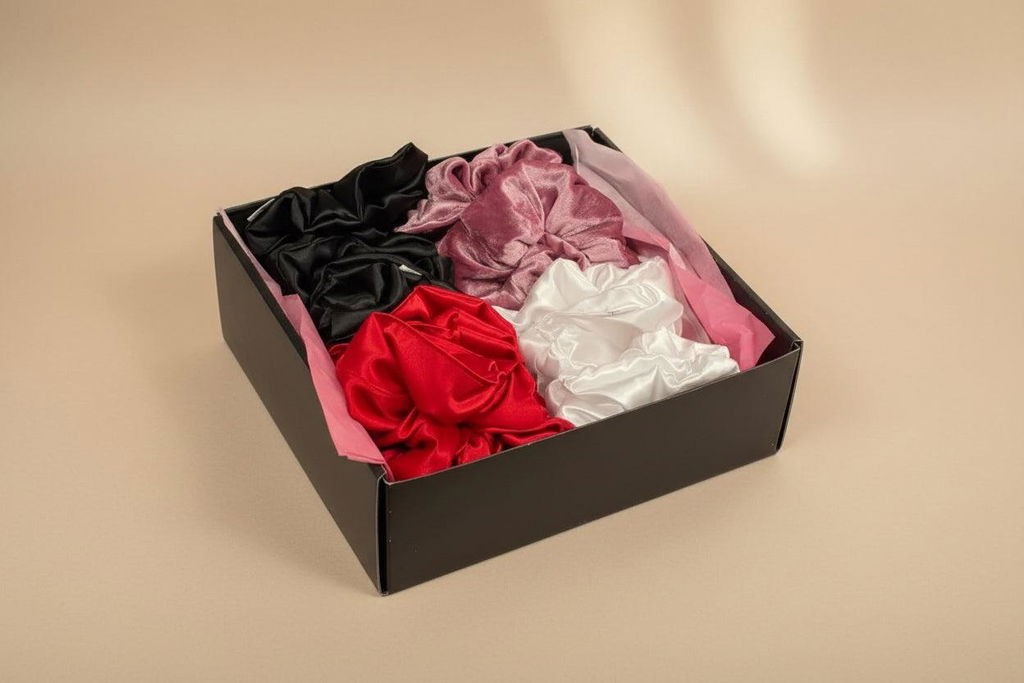
Satin scrunchies are the gold standard for frizz control, moisture retention, and cuticle protection. Satin's low friction lets hair glide rather than grip, making it ideal for curly, coily, and fragile hair. It's also the best choice for overnight wear, protecting your strands through hours of sleep.
Cotton scrunchies are breathable and gentle, making them a solid option for everyday wear and sensitive scalps. They're comfortable and practical without sacrificing protection.
Velvet scrunchies feel wonderfully soft, but the raised nap creates microscopic ridges that can catch on curls during removal. They're best suited for straight or low-porosity hair in shorter-term wear.
The key principle across all types: wider fabric coverage means more even tension distribution, which means less breakage at any single point. Our handmade satin, cotton, and velvet scrunchies at Certified Scrunchie Inc. are crafted right here in Canada with exactly this in mind, designed to work for all hair types and textures.
Your Hair Deserves Better Than a 50-Pack of Elastics
Small daily choices add up. The accessory you reach for every morning, every gym session, every bedtime is either working with your hair or quietly working against it.
Switching isn't about perfection. It's about being intentional with what touches your hair every day. Our handmade, damage-free scrunchies are crafted with care by our woman-founded, minority-owned team right here in Canada, rooted in community, inclusivity, and genuine love for healthy hair.
Your strands, and your future self, will thank you. Have a beautiful day!! 💛